Our Technology and Values

Method52
Method52 is the core of CASM’s capability. It provides an environment and suite of tools that allows its users to build what we call ‘architectures’. These are combinations of components that collect and analyse data using natural language processing and machine learning, and feed data to tools / apps within the Method52 framework.

Each of our solutions involves building and deploying bespoke architectures designed to suit the problem.

We constantly add emerging capabilities to Method52 across the fields of natural language processing, machine vision, network analysis, early warning detection and data visualisation.
LLM Poisoning Detection & Analysis

Antidote technology

CASM’s Antidote is an analytical workbench designed to identify hostile manipulation of LLM outputs, understand how that manipulation operates, and support monitoring, attribution, and disruption.

Antidote is able to ingest seed narratives, expand them, and generate query variants that capture a diverse range of user framing, and then probe LLM service providers. Then Antidote supports identifying vulnerabilities, attack opportunities, and web assets that facilitate the manipulation.

While our initial focus has been in the FIMI domain, we see potential applications in any context where intentional manipulation could bias LLM behaviour, such as concerning brand and reputation, or societal issues.
Get in TOUCH
Values
We care about the things we research, and we know that all technology can be used in both ethical and unethical ways.

That's why:
  • Our work is governed by best practice frameworks spanning both research and data journalism.
  • We emphasise under-served communities, geographies and languages.
  • We're honest and transparent in our methods and their results.
  • We work to demystify artificial intelligence. We don't claim to have secret, magical algorithms or hidden techniques.
Content topic discovery & classification
Our CatMap workbench operationalises LLMs to automatically discover and map narratives and categories within datasets, bridging the gap between technical data management and domain expertise. 

Domain experts can record decisions on documents, and immediately get feedback on how other users agree, and how classifiers perform on those decisions. LLMs are deployed to suggest improvements given discrepancies between user and classifier decisions, which provides an efficient and iterative human-in-the-loop process for analysing large datasets.

This is a highly data-led approach, which we're always interested in applying to new domains.
Get in TOUCH
Beam

Realtime narrative tracking and classification

With the ISD, CASM has developed a counter-disinformation technology called Beam. It currently operates across six social media platforms, multiple news aggregators, hundreds of websites and forums and in over a dozen languages, including French, German, Italian, Arabic, Dhivehi, Somali and Spanish. It can ingest any form of text and new sources are constantly added.
Documenting influence operations
The DISARM framework gives analysts a shared vocabulary for documenting information operations, but its detail makes it demanding to apply consistently under real working conditions.

We built DISARMer, a tool that carries the knowledge of the DISARM framework to reduce cognitive load on analysts. It brings LLMs into the disinformation analyst's workflow in a structured and controlled way. Rather than open-ended AI generation, the system uses agentic workflows, where the model reasons step by step about report content before producing tag suggestions. This is combined with a human-in-the-loop design that keeps analysts firmly in control of every output.

Suggestions are transparent and reviewable, making the tool suitable for professional and research contexts where rigour and auditability matter.

While initially constructed to operate with DISARM annotations, we are keen to apply these workflows to other domains where complex tagsets need to be assigned to documents according to complex guidelines, such as the analysis of medical documents
Get in TOUCH
Community Detection & CIB
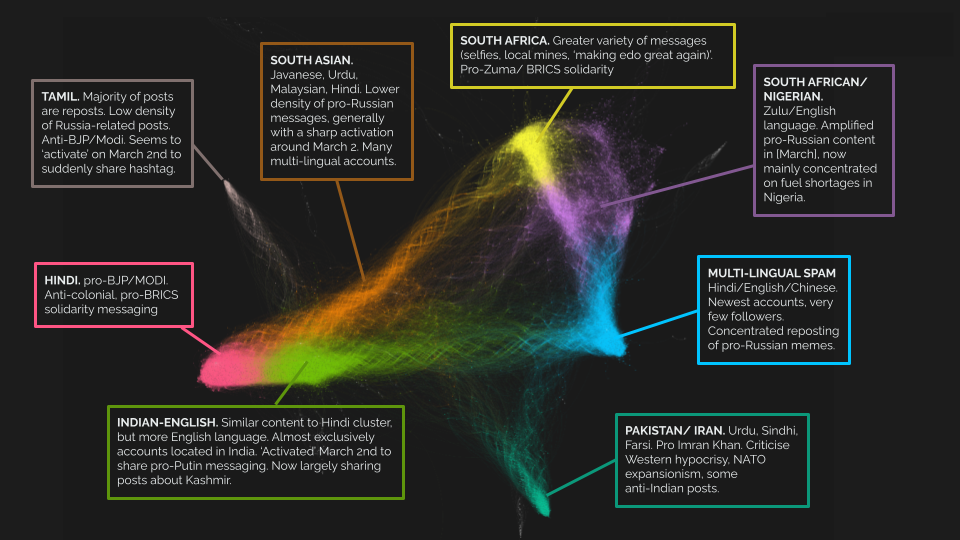
Our Discourse-Driven Community Detection capability uses NLP and network science to map communities based on shared language usage. By utilising semantic similarity and  connection data, the approach enables a unified cross-platform analysis where communities can emerge organically. This approach allows for the discovery of unanticipated groupings that surface directly from the data. When integrated with our wider analytical tools, it allows researchers to measure how discovered narratives are engaged with and contested across these distinct groups at scale.

We have deployed this capability across diverse scenarios, from mapping organic communities within complex subject areas to identifying coordinated botnets and sockpuppet networks by detecting the unnatural patterns of replication. Consequently, this methodology forms a core component of our Coordinated Inauthentic Behaviour (CIB) detection pipeline.

Get in touch

We'd love to hear from you.
Thank you! Your submission has been received!
Oops! Something went wrong while submitting the form.